
Millions of blogs are published every day, but not every one of them gets traffic. You can have the best arguments or perspectives in the content, but it still does not make it to the SERP.
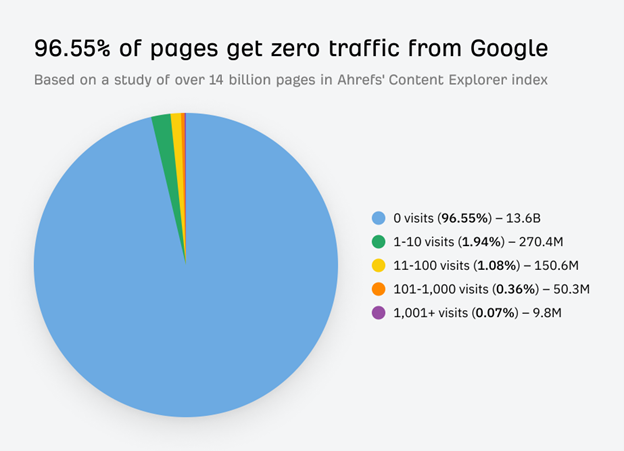
According to Ahrefs, 96.55% of pages get no traffic from Google.
And why is that? Because the content is not optimized for search engines. So no rankings. No clicks. No results.
So in this article, I’m going to tell you 10 easy-to-apply content optimization tips that will make your pages 3x more visible and bring consistent organic traffic.
10 SEO content optimization tips to improve your rankings
If you want to increase your website’s visibility, getting your content to rank higher is a smart way to do it.
But ranking on Google isn’t just about stuffing keywords or writing useful content. It’s about creating content that search engines understand and that users find valuable.
The following tips will help you optimize your content from all angles.
1. Use long-tail keywords in your content
When you’re writing content, don’t just target broad keywords like “digital marketing” or “best shoes.” These are too competitive and hard to rank for, especially if your site is new.
Instead, include long-tail keywords as well. Longer, more specific search phrases like “best running shoes for flat feet” or “content marketing tips for small businesses.”
They attract users who know exactly what they’re looking for. This means higher chances of selling your products or services. It will signal to Google that your content is useful and should rank higher.
2. Optimize your meta tags with keywords
Your meta title and description are what both search engines and users see first. So, do not waste that space. Even if your main keyword is long, try to naturally include it in both the meta title and meta description.
This helps Google match your page with the exact search queries easily. Plus, users are more likely to click when they see their search term within your snippet.
You can get help from generative AI like ChatGPT free at paragraph-generator.com, for this.
Just explain your topic and target keyword, and it will suggest optimized meta titles and descriptions instantly. It offers the latest version of GPT for free with unlimited access.
3. Add external and internal links
Linking is more powerful than most of us think. Internal links guide your readers and search engine crawlers to other helpful pages on your site. This improves navigation and time on site.
External links, when used smartly, show that your content is well-researched and connected to trusted sources. Google likes this.
So, link to your related blogs, product pages, or pillar content internally. And for external links, refer to stats, research, or guides from authoritative websites in your niche. Just make sure all links are relevant, working, and add value to the reader.
4. Use optimized infographics and images
Visuals are not just for making your content look good. They improve SEO as well when done right. Optimized infographics and images help you explain complex ideas quickly, and people spend more time on your pages, which also improves conversion. All of this sends positive signals to Google.
Along with visuals, you need:
- Descriptive filenames, e.g., seo-strategy-2025.png
- Alt text with keywords
- Compressed images to improve page load speed
- Responsive formats for mobile-friendliness
Infographics are also shareable. If your visuals get shared on other sites with a backlink, it improves your domain authority, too. So, always aim for visuals that educate people.
5. Write long-form content with depth
Short content is surely easier to write, but it rarely ranks high, especially for competitive keywords. Search engines favor comprehensive content that answers related questions and offers value to the reader.
That’s why the average length of the blogs that rank on SERPs is 1447 words, according to master blogging.
Because it naturally includes more keywords and covers a topic more comprehensively. It means ranking for multiple search terms and spending more time on your pages.
But remember, longer doesn’t mean just adding words. You can expand paragraphs with AI tools like paragraph-rewriter.net, which can increase words up to 3x.
But it will not increase valuable things in it like keywords, examples, stats, and even FAQs, where needed. You have to do it manually.
6. Try to get higher readability
If your content is hard to read, users will definitely leave. Google notices that. High readability will help users stay longer on your page and also make it easier for search engines to crawl and understand your content.
You can improve your readability by:
- Using short paragraphs and simple sentences
- Avoiding jargon or overly complex words
- Adding bullet points and numbered lists
- Breaking the text with headings and subheadings
- Choosing a readable font size and a mobile-friendly layout
You can also run your content through tools like an AI word changer. It will rewrite your content in a more reader-friendly way, especially helpful when you’re simplifying technical or complex topics.
Plus, wordchanger.net offers many rewriting tones like professional, academic, fluent, formal, and casual.
7. Optimize for featured snippets
Featured snippets are the AI answers that appear at the top of Google search results. Getting your content there means massive visibility and clicks.
For that, you need to take care of the following things:
- Use “question-based” long-tail keywords like “how to fix…” or “what is…”
- Structure your answers in a clear format within 40-50 words
- Use headings with the question (e.g., H2: How to Start a Blog)
- Use schema markup where possible to help Google understand your content structure
An AI answer generator is the best tool for this. Ask the question, and understand how pensiq.com formats the answer. Use that format in your content and improve your chances of ranking in the feature snippets.
8. Make your website mobile-friendly
Over 60% of all searches now come from mobile devices. So, if your website isn’t optimized for mobile, you’re hurting your rankings.
Google wants a smooth experience for its users. Hence, prioritizes mobile-friendly websites in its search results. That means your content might not rank, no matter how great it is, if your site loads poorly on smartphones or tablets.
You need to focus on the technical SEO of your site as well. Use responsive design and keep your fonts large enough to read on small screens. Moreover, avoid elements that require zooming or horizontal scrolling. It will not give a good user experience.
9. Refresh and update old content regularly
Old content that once ranked well can slowly lose visibility if it becomes outdated or irrelevant. Google favors fresh, accurate, and up-to-date content. So refreshing your older posts is a powerful content marketing strategy.
Revisit your top-performing blog posts every 3–6 months and update them with new stats, links, and examples. Even add new sections or FAQs based on recent trends or search queries.
This signals to Google that your site is active and committed to providing value. This simple habit can 3x your rankings without creating anything from scratch. That is why 72.9% of pages in Google’s top 10 are more than 3 years old, according to Ahrefs.
10. Get social signals through social media marketing
Social media doesn’t directly boost your SEO rankings, but the signals it sends can make a real difference.
Because when your content gets shared, liked, or commented on social platforms like Facebook, LinkedIn, or X (Twitter), it gains more visibility, more traffic, and often more backlinks. Google picks up on this user engagement and considers it a sign of quality.
This is why SEO is more of a multichannel strategy now. Content marketers share every new blog post on their brand channels as well. They even repurpose content into bite-sized posts for platforms like Instagram or LinkedIn and engage regularly with their audience.
Conclusion
Finally, start treating your content like a product: research what people want, improve the packaging (meta, visuals, formatting), and keep evolving based on feedback and performance.
With smart optimization, even a small website can outrank giants. So take these 10 tips seriously, apply them strategically, and watch how your rankings, traffic, and authority grow.
Start optimizing now and give your pages the visibility they truly deserve!