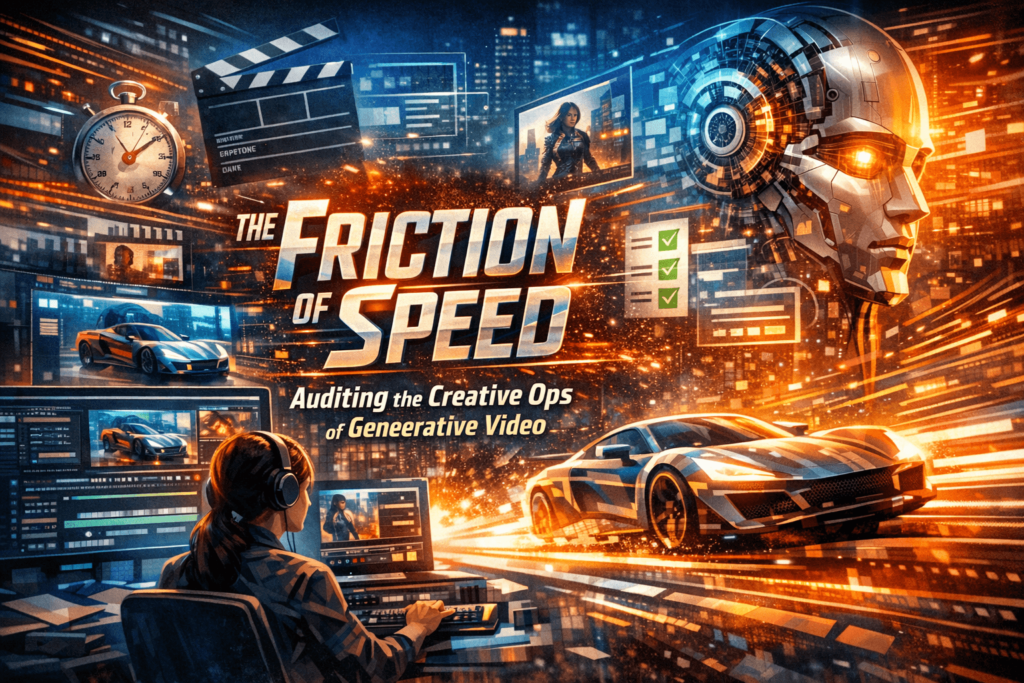
The narrative surrounding generative media has, for the last eighteen months, been dominated by the concept of “instant.” We are told that the barrier between ideation and execution has vanished. For a creative operations lead tasked with building repeatable, high-output asset pipelines, this narrative is as dangerous as it is attractive. Velocity is not a vacuum; in a professional production environment, speed without a corresponding evolution in review cycles and quality control leads to what I call “generative sprawl.”
When we integrate an AI Video Generator into a standard workflow, we aren’t just shortening the time it takes to render a frame. We are fundamentally shifting the bottleneck from the production desk to the directorial desk. The friction has moved. It is no longer about how long it takes to build a 3D environment or light a scene; it is about the cognitive load required to vet, filter, and refine the sheer volume of output these systems produce.
The Velocity Paradox in Creative Production
In traditional video production, velocity is limited by physical and technical constraints. You have a set number of shooting days, a finite budget for VFX artists, and a linear timeline for post-production. These constraints act as a natural filter. Because every second of footage is expensive, the creative team is forced to be intentional.
With the advent of high-fidelity tools like an AI Video Generator, those constraints are stripped away. A single operator can generate fifty variations of a ten-second clip in an afternoon. On paper, your production throughput has increased by 1,000%. In reality, your review cycle just became a nightmare.
Creative operations must now account for “selection fatigue.” When an editor is presented with fifty “good enough” shots rather than one “crafted” shot, the decision-making process slows down. This is the first major limitation of current generative workflows: the time saved in creation is often clawed back by the time required for curation. Until we have better metadata and semantic search for generated assets, the human eye remains the ultimate, and most expensive, bottleneck.
Restructuring the Review Cycle
The traditional “Review-Feedback-Revised” loop was built for a world where changes took days. If a director wanted a different camera angle, the VFX team went back to the drawing board. Today, that feedback can be addressed in minutes by tweaking a prompt or adjusting a seed value within an AI Video Generator.
This immediacy requires a shift in how we handle stakeholder expectations. If a client knows a change can be made “instantly,” they are prone to endless tinkering. This “infinite iteration” trap can actually extend delivery timelines beyond what they were in the pre-AI era.
To combat this, production leads are beginning to implement “generative gates.” These are predetermined points in the workflow where the team moves from broad experimentation to locked-in assets. 1. The Broad Phase: Using a multi-model approach (incorporating engines like Kling, Sora, or Veo) to explore visual directions. 2. The Lock Phase: Selecting the core generative logic and sticking to it, resisting the urge to re-roll the dice. 3. The Polish Phase: Moving the generated assets into traditional software for upscaling, color grading, and temporal fixing.
The Technical Debt of Generative Assets
One of the more sober realities of the current landscape is the lack of “source files.” When you use an AI Video Generator, you are essentially working with baked pixels. You don’t have a 3D project file with layers, lights, and cameras that you can adjust independently. You have a flat video file.
This introduces a specific kind of technical debt. If a client likes a character but hates the background, you can’t simply hide the background layer. You have to re-generate the entire scene, hoping to maintain character consistency, or rely on heavy-duty masking and in-painting. This is a moment of necessary uncertainty: we cannot yet guarantee 100% frame-by-frame control. The “hallucinations” that occur in the background of a shot or the slight morphing of a face are not just bugs; they are inherent to the current diffusion and transformer architectures.
For an operations lead, this means the “delivery” of an AI-generated video is rarely the end of the job. It is usually the start of a traditional clean-up phase. If your pipeline assumes the AI output is the final product, your quality bar will inevitably drop. The most successful teams treat the AI Video Generator as a high-fidelity “plate generator” rather than a finished-film button.
Platform Consolidation vs. Tool Fragmentation
The current market is fragmented. One day a new model leads in temporal stability; the next, another model wins on photorealism. For a content team, managing fifteen different subscriptions and logins is an operational disaster. This is where platforms like MakeShot provide utility—not necessarily by inventing a new model, but by acting as a unified interface for the most capable engines available, from Google Veo to Kling and beyond.
From a procurement and security standpoint, centralizing these tools is critical. Creative ops need to know where the data is going, who has access to the “pro” tiers, and how the credits are being burned. Moving between standalone tools for images and then jumping to a separate AI Video Generator creates unnecessary data silos. A unified workflow allows an operator to move from an initial image concept to a motion-rigged video without leaving the ecosystem, reducing the “context-switching tax” that plagues modern creative teams.
The Myth of the ‘One-Click’ Workflow
We must reset expectations regarding the level of “native” talent required to operate these tools. There is a persistent myth that an AI Video Generator replaces the need for an editor or a cinematographer. Our internal benchmarks suggest the opposite.
The best outputs come from operators who understand the fundamentals of film: three-point lighting, focal lengths, shutter speed, and color theory. A prompt that specifies a “35mm anamorphic lens with a shallow depth of field” will consistently outperform a generic “cinematic” prompt.
The limitation here is that the AI doesn’t “know” these rules; it only knows how to mimic the patterns of data it was trained on. If your operator doesn’t know the difference between a dolly zoom and a pan, they won’t know how to prompt for it—or more importantly, they won’t know when the AI has failed to deliver it correctly. The “human in the loop” is not a placeholder; they are the quality control officer for a system that has no concept of quality.
Measuring ROI in the Generative Era
How do we quantify the success of an AI Video Generator in a professional pipeline? It isn’t just “dollars saved.” We look at three specific metrics: Iteration Density: How many viable creative directions were explored in the first 24 hours of the project? Asset Reusability: Can the generated elements be broken down (using AI masking) and used across different social formats? Time to First High-Fidelity Comp: How quickly can we show a client something that looks like the final product, rather than a storyboard?
In performance marketing, where the volume of creative is the primary lever for success, the AI Video Generator is a massive win for throughput. For high-end brand films, the utility is currently more in the pre-visualization stage. Being honest about these use cases prevents the team from over-committing to a technology that may not yet be ready for a 4K Super Bowl spot without significant human intervention.
Managing the Unpredictable
The final audit of any generative pipeline must include a plan for failure. Unlike a traditional render farm, which will produce exactly what it is told to produce (errors notwithstanding), an AI Video Generator is probabilistic. You might get the perfect shot on the first try, or you might spend four hours chasing a specific movement that the model simply cannot comprehend.
This unpredictability is the hardest thing for creative ops to bake into a schedule. You cannot tell a producer that a shot will be ready at 4 PM if that shot relies on a model’s “mood.”
To manage this, we build “buffer iterations” into our timelines. We assume that for every one usable second of footage, we will generate ten seconds of unusable noise. By budgeting for this waste, we stabilize the delivery schedule. We treat the AI not as a reliable machine, but as a highly talented, somewhat erratic freelancer. You give it a clear brief, you give it the right tools, and you give yourself enough time to fix its mistakes.
Strategic Delivery
The goal of integrating an AI Video Generator into your workflow should not be to replace your creative team, but to unburden them from the mechanical “grunt work” of production. When the time to create a baseline visual drops to near-zero, the value of the creative idea—the strategy, the pacing, and the emotional resonance—actually increases.
As the tools evolve, the most successful creative operations will be those that prioritize the “Review” and “Refine” stages over the “Generate” stage. We are moving out of the era of “How do we make this?” and into the era of “Which of these is right?” The friction of speed is real, but for those who build the right gates and filters, it is the most significant competitive advantage in the modern media landscape.