
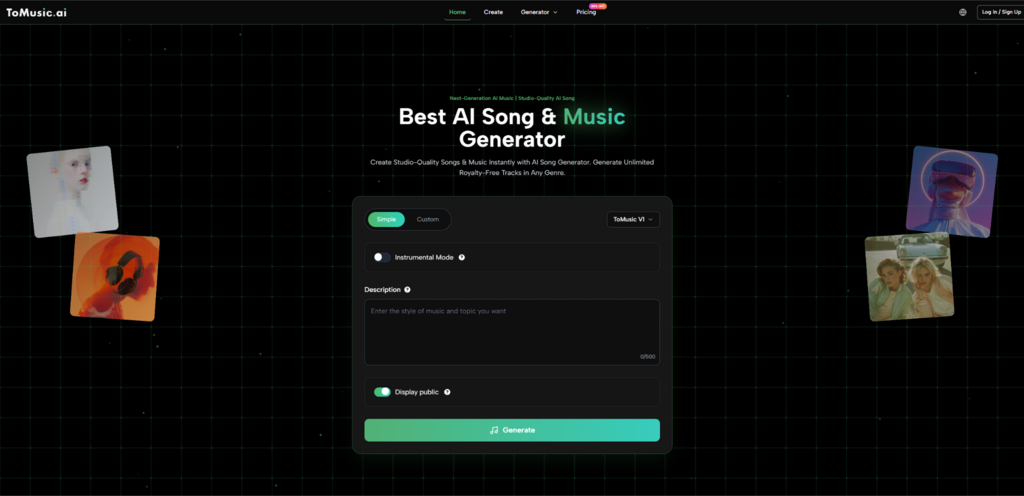
You can open an AI Music Generator and get a full track in minutes, but the real leap happens when you stop treating it like a slot machine and start treating it like a workflow: prompt, compare, iterate, ship.
With Text to Music, the fastest path to a usable result is not “one perfect prompt.” It is building a tiny loop you can repeat: describe, generate, evaluate, and adjust—until the track matches what your project actually needs.
Why “One Prompt” Thinking Usually Breaks Down
The hidden reason most first drafts disappoint
When a tool can generate “anything,” it’s easy to ask for everything. That’s how you get music that sounds technically complete but emotionally unfocused.
A better mental model: specify what must not change
In practice, you get more consistent outcomes by deciding two or three non-negotiables first—then letting the model fill in the rest.
Two Modes That Change Your Role As A Creator
Simple mode: describe the destination
Simple mode is best when you care about vibe and usability more than lyrical precision. You describe style, mood, tempo, and instrumentation, then generate.
Use it when you need volume and direction
Content schedules, background beds, and rapid drafts benefit from speed. You can produce multiple variations quickly and keep only the ones that “land.”
Custom mode: write the map
Custom mode is for when words and structure matter. You provide lyrics and guide form with section tags like Verse, Chorus, Bridge, Intro, and Outro.
Use it when narrative and timing matter
If your track needs a chorus that hits at the same moment as a scene shift, custom structure is usually the right starting point.
A Practical Model Strategy: V1 To V4 Without Guesswork
Think of the models as different instruments
ToMusic positions multiple models—V1 through V4—with different strengths. The key is not “which is best,” but “which is best for this step.”
A stable pattern: draft fast, then refine
Many creators start with faster generations to explore ideas, then rerun the best concept on a model that prioritizes expression or longer compositions.
The Three-Step Process That Matches The Official Flow
Step 1: Choose mode, then write one clear input
Pick Simple mode for descriptive prompts, or Custom mode for lyrics plus section tags.
Step 2: Select a model and generate multiple variations
Run at least two generations with small changes: one focused on instrumentation, one focused on mood and energy.
Step 3: Save, compare, and iterate from the best draft
Use the saved outputs as your reference set; iterate by editing only one variable per run (tempo, instrumentation, vocal feel, or structure).
A Comparison Table That Helps You Decide Faster
|
What you care about
|
Simple mode
|
Custom mode
|
Why it matters in practice
|
|
Speed to first draft
|
Strong
|
Medium
|
Simple prompts reduce setup time
|
|
Control over lyrics
|
Limited
|
Strong
|
Lyrics + section tags shape phrasing and sections
|
|
Structural predictability
|
Medium
|
Strong
|
Verse/Chorus tags reduce “wandering” songs
|
|
Best for background music
|
Strong
|
Medium
|
Descriptive generation fits utility tracks
|
|
Best for story-driven songs
|
Medium
|
Strong
|
Written structure keeps narrative coherent
|
|
Iteration style
|
Prompt tweaks
|
Lyric + structure edits
|
You change fewer variables each run
|
What The Music Library Changes About Your Output Quality
Saving is not just convenience—it’s calibration
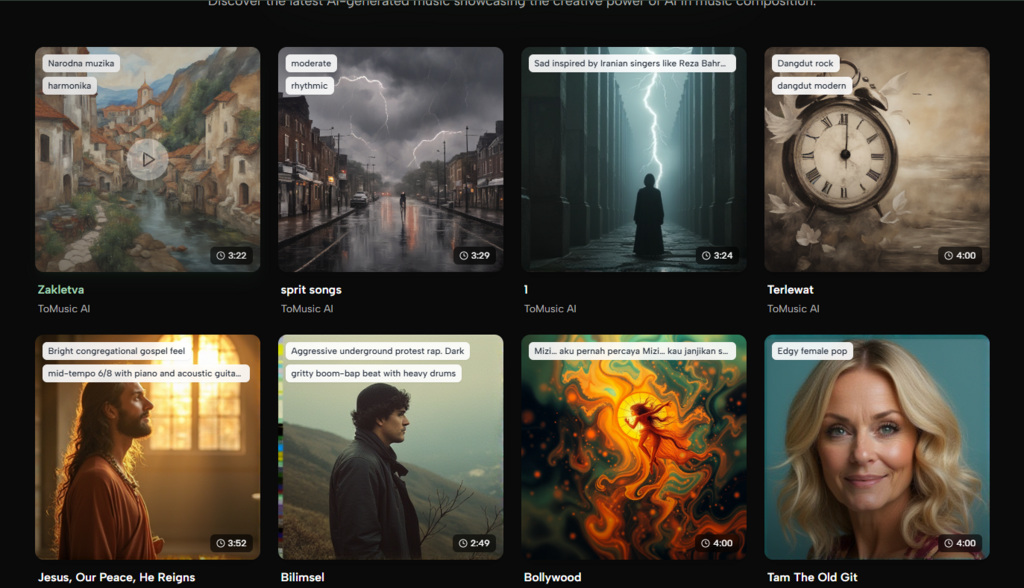
ToMusic’s Music Library is positioned as a personal hub that automatically saves what you generate, with metadata like titles, tags, lyrics, and generation parameters. That matters because it turns “I liked that one version” into “I can reproduce that direction.”
A simple habit that improves results
Name your good drafts by what they do, not what they are: “calm intro bed,” “punchy chorus idea,” “warm acoustic hook.” That labeling makes future prompts better.
Limitations Worth Knowing Before You Rely On It
Prompt precision still matters
In my testing mindset, the tool feels more stable when your prompt has a clear center. If you ask for five genres and three emotions, you often get a compromise.
Expect iteration, not perfection
Even strong generations may need a few reruns to land the exact energy you want. Treat early outputs as candidates, not final answers.
A Small Prompt Template That Keeps You Honest
Use this structure to reduce randomness
Genre + mood + tempo + instruments + use case
Example pattern (write your own specifics): “downtempo electronic, reflective, 90 BPM, soft synth pads and light percussion, designed for a calm tutorial intro.”
What It Means For Creators Who Don’t Want A Studio Setup
The real value is not replacing musicians
It’s compressing the distance between intent and audio. When you can hear ideas quickly, you make better decisions—because you’re no longer imagining a track, you’re evaluating one.
If you’re building for content, consistency wins
A repeatable loop—mode, model, iteration—beats chasing a mythical “perfect prompt.” That’s how AI generation starts to feel less like luck and more like craft.