
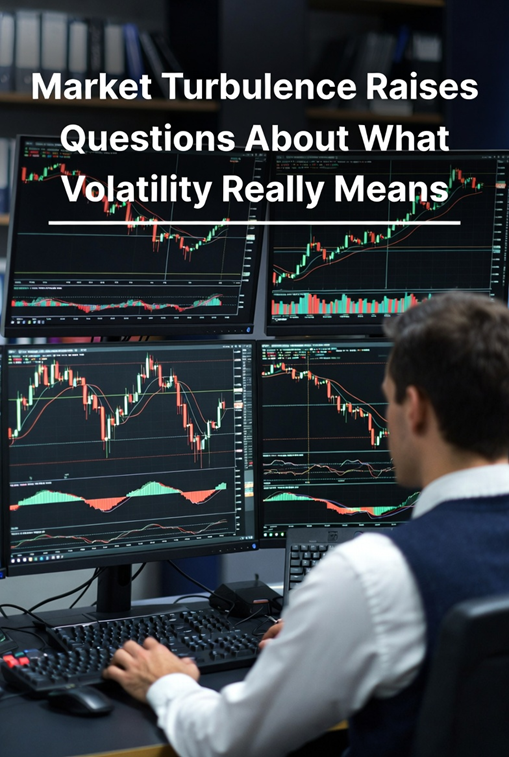
Market turbulence hits hard these days, with prices whipping around faster than most traders can blink. One minute everything looks calm, the next a single headline sends pairs or crypto plunging double digits. Volatility sits right at the center of it all, and honestly, a lot of beginners (and even some pros) still ask the same question: what does volatility really mean in trading?
I have traded through enough wild swings to know it is not just “prices moving a lot”. It measures how wildly and quickly an asset deviates from its norm, signaling risk, opportunity, and pure chaos. In forex, crypto, stocks, it defines everything from position sizing to strategy choice. This piece breaks down the real definition, measurement tools I actually use, causes behind spikes, real-world impact on different markets, and how to handle it without blowing up. Stick around, these details save accounts.
What Volatility Actually Means
Volatility quantifies the degree and speed of price fluctuations around the average. High volatility means big, rapid swings, low means steady creeping moves. It is relative: a 2% daily move might be normal for crypto but insane for major forex pairs.
Think of it as market breathing rate. Calm periods feel boring but safe, turbulent ones offer huge pips if you time right, but punish mistakes brutally. In my early days I chased every spike without understanding this, ending up stopped out repeatedly because volatility expanded stops faster than profits.
It is not inherently good or bad. For scalpers, high volatility creates frequent impulses to grab 8-15 pips. For position traders, it means wider stops and emotional stress. The key insight: volatility measures uncertainty, and uncertainty equals risk multiplied by opportunity.
How Traders Measure Volatility
Traders rely on concrete tools to quantify volatility instead of gut feel. Historical volatility looks back at past price action using standard deviation. Implied volatility forecasts future swings via options pricing. Both help set realistic expectations.
Most platforms give you ATR for daily range, Bollinger Bands for channel squeezes/expansions, VIX for broad market fear. Beta shows how an asset moves relative to the index. I always check ATR first on any pair before entering; if it jumps from 40 to 120 pips overnight, I halve position size immediately.
Here is a quick comparison of the main volatility measures I use across forex and crypto, with typical values in current conditions.
| Measure | Type | Best For | Calculation Basis | Typical Reading (Majors/Crypto) | Practical Use in Trading |
| ATR | Historical | Daily range | Average true range over 14 periods | 40-80 pips / 3-8% | Stop placement, position sizing |
| Bollinger Bands | Channel + deviation | Squeeze/expansion | MA ± 2 std dev | Bandwidth 0.5-2% / 5-15% | Breakout signals, mean reversion |
| Standard Deviation | Statistical | Return variability | √(variance of returns) | 0.8-1.5% daily / 4-10% | Risk assessment, Sharpe ratio |
| VIX | Implied | Market fear gauge | S&P 500 options prices | 12-20 calm / 30+ panic | Broad sentiment, hedging decisions |
| Beta | Relative | Asset vs market | Cov(asset, market)/Var(market) | 0.8-1.2 stocks / N/A crypto | Portfolio diversification |
ATR stands out for short-term trading because it adapts to recent action without lagging too much.
What Drives Volatility Spikes
Volatility explodes when supply/demand balance gets shocked. Fundamentals like surprise rate hikes or weak jobs data trigger it. Geopolitics (wars, tariffs) add panic. Large institutions dumping positions create cascading moves.
Market psychology amplifies everything: fear spreads faster than greed. In crypto, one whale move or tweet can swing 10% in minutes. Forex reacts slower but news like NFP still spikes GBPUSD 150 pips in seconds.
I remember trading during a major central bank surprise in 2024: EURUSD volatility tripled intraday. Stops got hunted left and right because everyone expected the same direction, but institutions faded the move. Lesson: spikes often come from unexpected news + crowded trades.
Volatility in Action for Forex and Crypto Traders
Forex majors like EURUSD average 0.5-1% daily moves, but during events it hits 2-3%. Crypto like BTCUSD routinely swings 5-10% daily. High volatility suits aggressive styles but destroys undercapitalized accounts.
On EURUSD M15, I use ATR to set stops: if ATR=60 pips, stop at 1.2×ATR (~72 pips), target 1.8×ATR (~108 pips) for RR 1:1.5. Risk 0.75% on $20k account means $150 max loss, position size ~0.2 lots if pip value $10.
Recently on BTCUSD during a funding rate flip, price dropped 8% then reversed 12%. Entered long after Bollinger squeeze breakout + ATR expansion confirmation. Stop below low -2%, target next resistance. Closed +7.2% in 4 hours. Without volatility filter, I would have shorted the initial drop and got wrecked.
Pros: bigger edges, more setups. Cons: wider spreads, slippage, emotional burnout. Reduce size in high vol, avoid news unless hedging.
Conclusion
Volatility boils down to how wildly and fast prices deviate from average, driven by uncertainty in supply, demand, news, and psychology. It creates both massive opportunities for quick profits and brutal risks of outsized losses. Measure it with ATR, Bollinger, VIX, and adjust strategy accordingly: tight risk in spikes, bigger positions in calm.
Mastering volatility means surviving long enough to profit from it. Always size down when ranges expand, demand confluence before entry, and never revenge trade after a volatility-induced stop. Discipline turns turbulence into an ally. For a deeper dive into definitions, measurements, causes, and real trader tips on handling market swings, check this solid guide: what does volatility mean. It covers the essentials you need to trade smarter in any conditions. Stay calculated, and the market’s chaos becomes your edge.