
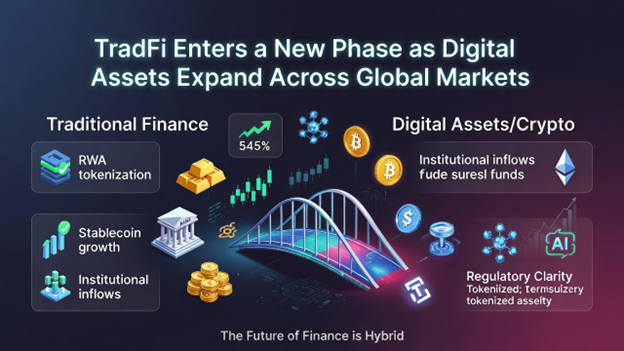
Traditional finance infrastructure faces real pressure to evolve. Markets no longer operate in silos – volatility jumps across asset classes instantly, macro events trigger correlated moves everywhere, and traders demand seamless access without constant conversions or fragmented accounts.
In current conditions, with institutional capital flowing steadily into digital assets and tokenization gaining scale, the old separation between crypto and TradFi feels outdated. Platforms now prioritize unified environments where one can balance powers exposure to forex, commodities, indices, equities, and crypto simultaneously.
I’ve traded through multiple cycles where siloed accounts cost opportunities – missing a gold breakout because funds sat in BTC, or watching equity moves while waiting for fiat transfers. The shift to multi-asset infrastructure fixes exactly that. Before exploring how it works, note that TradFi access powered by crypto deposits represents one of the cleanest ways to navigate this new reality without leaving digital capital idle.
This adaptation isn’t optional anymore. It’s structural, driven by efficiency demands, regulatory progress, and trader behavior. Let’s dissect the key changes and how to position for them.
Core Drivers Forcing Infrastructure Evolution
Several forces converge to push TradFi toward multi-asset setups. First, crypto-native habits – 24/7 trading, high leverage, instant settlements – spill over into traditional markets. Traders rotate capital fluidly between BTC volatility and gold safe-haven flows or index trends during risk-on periods.
Second, institutional adoption accelerates the process. Large players allocate to digital assets but want them integrated into broader portfolios. Tokenized treasuries, stablecoin settlements, and on-chain collateral demand infrastructure that handles both worlds without friction.
Third, regulatory clarity removes roadblocks. Frameworks now allow compliant bridges between fiat rails and blockchain, enabling platforms to offer regulated CFDs on global assets while accepting crypto margin.
The result? Unified wallets and margin systems replace separate accounts. Capital efficiency improves dramatically – no more idle funds waiting for transfers, reduced opportunity costs, and better risk management across correlated exposures.
This isn’t hype. It’s practical response to how modern portfolios actually behave in volatile environments.
How Multi-Asset Platforms Bridge the Gap
Modern infrastructure centers on crypto as base capital. Deposits in USDT, BTC, ETH, or others fund positions directly in forex pairs, precious metals, energy commodities, major indices, and single stocks via CFDs.
Execution stays institutional-grade: tight spreads from 0.1 pips on majors, leverage up to high levels on select instruments, negative balance protection, and advanced tools like MT5 integration for automated strategies.
The key advantage lies in capital mobility. A single margin pool supports diversified trades – long gold as inflation hedge while shorting overvalued indices, or using stablecoin collateral for crypto futures without liquidation risks from cross-asset swings.
Interoperability improves too. Platforms support multiple networks for deposits, instant confirmations, and same-day withdrawals, minimizing downtime.
These features align perfectly with current market dynamics: macro uncertainty drives cross-asset rotations, while blockchain efficiency sets new standards for speed and cost.
Here’s a practical comparison of traditional vs. adapted multi-asset infrastructure for active traders:
| Aspect | Traditional Setup | Multi-Asset Crypto-Funded Setup | Key Benefit in Current Conditions |
| Funding Method | Fiat wires/transfers only | Crypto deposits (USDT/BTC/ETH) instant | No delays, capital always deployable |
| Asset Access | Separate brokers for FX/stocks/commodities | Unified platform: 250+ instruments | One interface, faster rotations |
| Margin & Collateral | Fiat or limited assets | Crypto as direct margin | Higher efficiency, reduced idle capital |
| Trading Hours | Session-based | 24/7 on most CFDs/futures | Capture global moves anytime |
| Leverage & Costs | Standard, often lower | High leverage, low spreads/zero commissions | Amplified exposure with controlled costs |
| Risk Tools | Basic stops | Advanced: auto-trading, negative protection | Better drawdown management |
This table highlights why the adaptation feels inevitable. Efficiency gains compound quickly for anyone trading multiple classes.
Practical Steps to Leverage the Shift
Start by auditing your current setup. Calculate opportunity costs from fragmented accounts – how many trades did you miss due to transfer delays or idle funds?
Next, select platforms with true unification. Look for crypto deposits without mandatory fiat conversion, segregated funds, strong custody (like Fireblocks), and pro tools (MT5/PXTrader equivalents).
Test small. Deposit a modest amount in USDT, execute cross-asset trades, and monitor execution quality during volatile periods. Track effective costs: spreads + funding rates + slippage.
Build diversified strategies. Example: allocate 40% to crypto momentum, 30% to commodity hedges (gold/oil), 20% to index beta, 10% to forex carry. Use unified margin to rebalance instantly when correlations shift.
Risk rules stay non-negotiable. Position size at 1-2% per trade max, hard stops always, monitor cross-asset correlations (crypto often leads risk-off moves).
One calculation worth running: Effective yield drag = (Volatility of collateral × Time horizon) – Platform funding rate. If drag exceeds expected edge, adjust allocation.
Scale gradually as execution proves consistent.
Remaining Challenges and Realistic Path Forward
Friction persists. Liquidity varies across tokenized or CFD products – deeper in majors like EUR/USD or gold, thinner in niche shares.
Counterparty risk exists even on regulated platforms. Stick to licensed entities with proof-of-reserves and insurance.
Volatility amplification through leverage demands discipline. High exposure cuts both ways.
Still, trajectory clear. As institutional flows grow and tokenization scales, multi-asset infrastructure becomes standard. Platforms adapting now capture the edge.
Conclusion
TradFi infrastructure adapting to multi-asset trading marks a fundamental upgrade. Unified platforms powered by crypto deposits eliminate old frictions, boost capital efficiency, and align perfectly with how traders and institutions operate in interconnected markets.
Focus on practical implementation: test unified access, build cross-asset strategies, enforce strict risk controls, and monitor macro correlations. The setup rewards flexibility without sacrificing professionalism.
In environments where volatility jumps unpredictably across classes, this infrastructure provides real advantage. Capital stays active, opportunities stay in reach, and portfolios become more resilient. Adapt early, trade smart, and let structural tailwinds work in your favor. The era is here – position accordingly.