
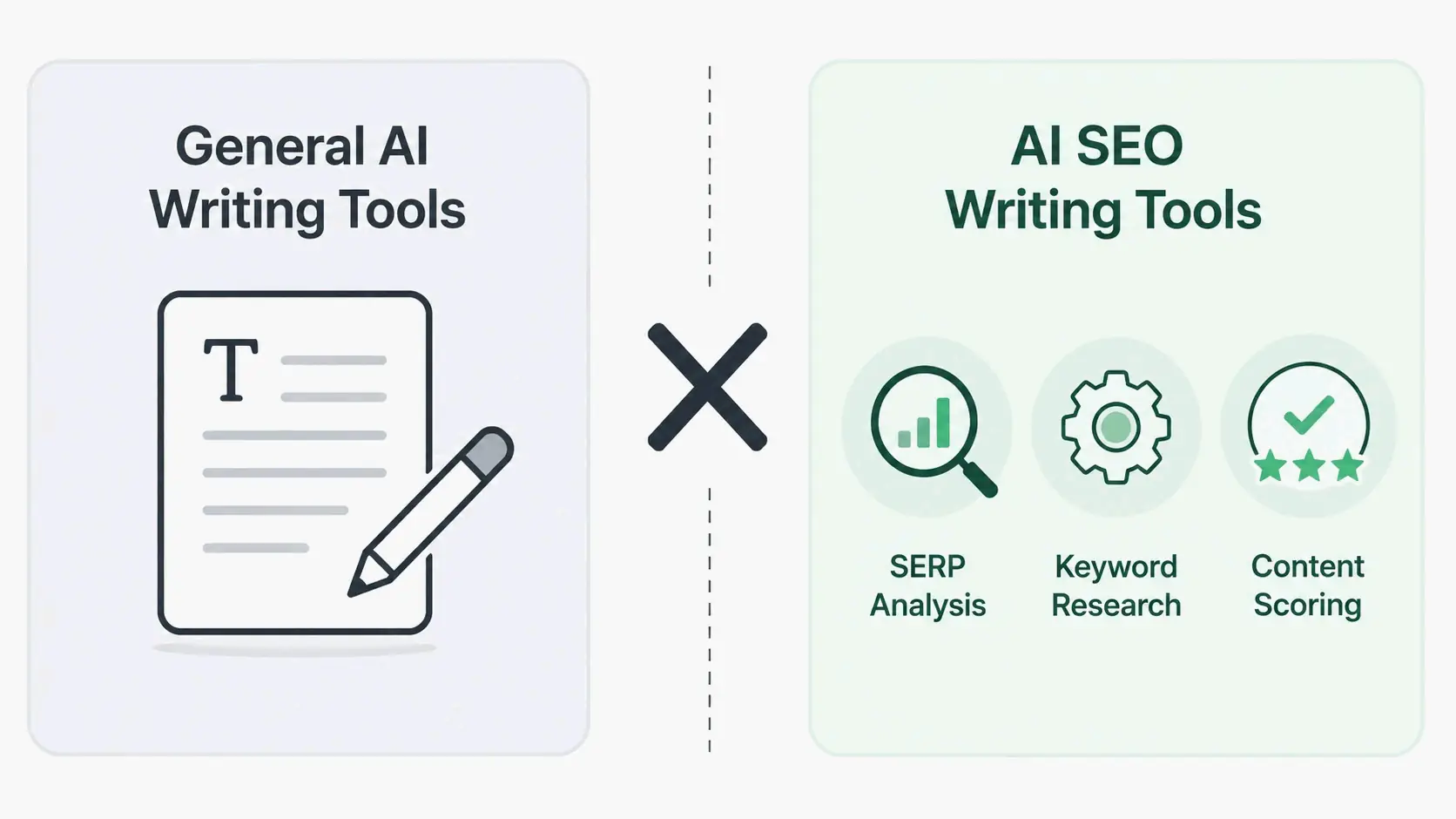
The best AI SEO content writer does more than just generate text. It combines real-time SERP analysis, NLP optimization, and automated publishing to create content that ranks in both search engines and AI answers. Unlike generic AI writers, these specialized tools use keyword intelligence, content scoring, and Generative Engine Optimization (GEO) to match how modern search algorithms—and AI models like ChatGPT—evaluate relevance. GEOWriter is itself an AI SEO content writer: it combines live SERP analysis, structured content generation, E-E-A-T alignment, automated visuals, and one-click WordPress publishing into one end-to-end workflow, producing publication-ready SEO content in roughly five minutes.
How to Choose the Best AI SEO Content Writer in 2026: 5 Key Criteria
Choosing the right AI SEO content writer goes beyond just looking at output quality. In 2026, the tools that actually move rankings share five core capabilities: E-E-A-T alignment, real-time SERP analysis and content scoring, Generative Engine Optimization (GEO) support, workflow automation, and transparent pricing. Each of these directly determines whether your content competes in traditional search results and AI-generated answers alike.
What an AI SEO Content Writer Is (and Isn’t)
An AI SEO content writer is a specialized platform that uses AI to create content designed to rank in search engines (and increasingly, in AI-generated answers). As Outrank explains, that’s what separates these tools from general-purpose AI writing assistants like ChatGPT. Generic AI writers can produce coherent text on demand, but they lack keyword intelligence, SERP analysis, and on-page optimization. An AI SEO content generator bundles all these into a single workflow: keyword research feeds the content brief, the brief shapes the article structure, the structure follows SEO signals from live search data, and the published piece becomes part of a larger content strategy.
Why E-E-A-T Still Matters in 2026
Google’s quality standards haven’t changed. At the April 2026 Google Search Central Live event in Canada, Danny Sullivan, Director of Google Search, put it this way: “SEO and AI SEO are not separate disciplines. The fundamentals that have always mattered—helpful content and genuine expertise—are the same fundamentals that AI search rewards.” Evaluation from Behind Rankings shows Google now distinguishes between commodity content—generic material easily copied by AI—and non-commodity content grounded in real experience and original data. The best AI SEO tools need to help you produce the latter to meet E-E-A-T benchmarks.
The Role of NLP and Content Scoring
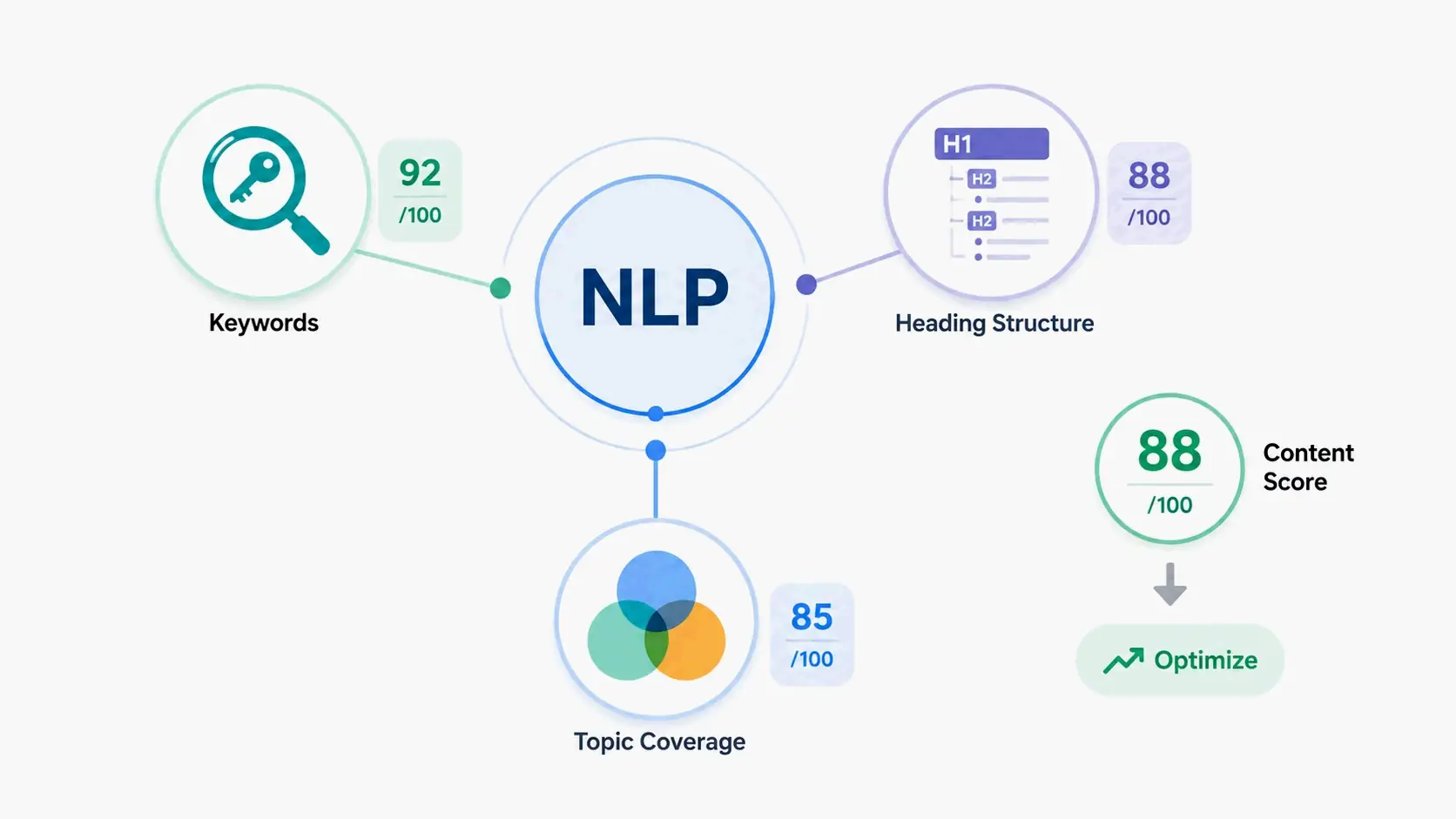
Natural Language Processing (NLP) helps AI SEO writers spot the semantically related terms and entities Google expects to see in authoritative content. Content scoring tools like Surfer SEO’s Content Score give real-time feedback on on-page optimization—measuring keyword usage, heading structure, and topical coverage against top-ranking competitors. According to Surfer, one team added NLP-recommended keywords to already optimized articles and hit top five in Google search, with a 15% organic traffic boost within the first month.
Top 6 AI SEO Content Writer Tools Ranked for 2026
Every tool in this ranking was evaluated against the five criteria above: E-E-A-T alignment, real-time SERP analysis and content scoring, GEO support, workflow automation, and pricing scalability. These six platforms represent the strongest options across different use cases and budgets.
1. Semrush One – Best All‑in‑One for SEO + AI Visibility
Semrush One merges Semrush’s traditional SEO tools with a new AI Visibility Toolkit, letting you track brand presence across Google, AI Overviews, ChatGPT, Gemini, and Perplexity—all from one dashboard. As Freddie Chatt notes, this solves the problem of scattered AI search data: “The main problem with AI search visibility right now is that the data is scattered. Semrush One pulls it into one place, with one login.”
Key features:
- Visibility Score measuring brand presence across AI search surfaces
- Prompt Research and Daily Prompt Tracking across 261 million prompts in 32 countries
- Cited-source analysis across ChatGPT, Google AI Mode, AI Overviews, Gemini, and Perplexity
- MCP server integration for pulling live Semrush data into Claude, ChatGPT, and Cursor
Pricing: AI Visibility Toolkit at $99/month; Semrush One Starter at $199/month with a 14-day trial.
Strengths: Unifies traditional SEO and AI visibility tracking; largest prompt database in a commercial tool.
Weaknesses: Broad feature set creates a learning curve for new users.
Best for: In-house teams and agencies needing a single platform for both traditional SEO and AI search monitoring.
2. Surfer SEO – Best for Content Optimization and NLP Scoring
Surfer SEO is a content optimization platform used by 150,000+ professionals, including teams at ClickUp, Bolt, and Allianz. Its Content Editor provides real-time NLP-driven feedback on keyword usage, heading structure, and word count by analyzing top-ranking SERP pages.
Key features:
- Content Score with real-time optimization metrics
- AI Content Writer powered by GPT-4o
- Auto Internal Links for contextual internal linking
- AI Tracker for monitoring brand visibility in ChatGPT, Perplexity, and AI Overviews
- Coverage Booster identifying missing facts and subtopics
Pricing: Essential plan at $99/month (30 content edits); Scale at $219/month.
Strengths: Industry standard for NLP-based content scoring; strong integration ecosystem.
Weaknesses: No built-in AI humanizer; can lead to over-optimized content if suggestions are followed rigidly.
Best for: Agencies and in-house teams managing data-driven content optimization at scale.
Notable case: As reported on Surfer’s site, Matthew Woodward hit #1 two days after deleting 85% of his content based on Surfer’s analysis.
3. Keyword Insights – Best for Keyword Clustering and Topic Research
Keyword Insights automatically clusters keywords based on SERP similarity rather than phrase matching, taking the guesswork out of content strategy. As Freddie Chatt describes, “Instead of manually working out whether ‘best running shoes for men’ and ‘top men’s trainers’ should be separate pages or one, Keyword Insights gives a clear answer based on how Google treats those queries.”
Key features:
- SERP-based keyword clustering with search intent assignment
- Content brief builder pulling headings, PAAs, and competitor structure
- Auto-citations feature ensuring every claim is backed by a source
- WordPress integration for direct CMS connection
Pricing: Paid plans available (specific pricing not disclosed in source materials).
Strengths: Eliminates cannibalization risks; ideal for scaling content strategies.
Weaknesses: Can slow down with very large keyword sets.
Best for: Content strategists and agencies building topical authority clusters at scale.
4. Outrank – Best for Fully Automated Content Production
Outrank is an automated content engine that handles the entire pipeline—from keyword discovery to publishing and link building. According to the platform, it generates roughly 30 articles per month, each running through keyword targeting, SERP analysis, content briefing, AI generation with brand voice calibration, and SEO optimization.
Key features:
- Automated keyword discovery prioritizing high-traffic, low-difficulty opportunities
- Content generation with articles up to 3,000 words, structured headings, and internal links
- Direct CMS publishing to WordPress, Webflow, Shopify, Framer, Notion, and Wix
- Backlink Exchange network for contextual link building
- Directory submission service for 350+ directories
Pricing: Core platform at $99/month; Outrank Agency (with human curation) at $1,499/month.
Strengths: End-to-End automation eliminating publishing friction; built-in authority building.
Weaknesses: Less control over individual article nuances.
Best for: Businesses wanting a “set-and-forget” content system without a dedicated content team.
5. AISEO.ai – Best for AI Humanization and GEO Suites
AISEO.ai combines a long-form SEO writer, built-in AI humanizer, GEO optimization suite, and “Outrank Mode” that reverse-engineers top-ranking content. As identified by Scribe, it’s the only tool in the category that combines all these functions under one roof.
Key features:
- AI Humanizer rewriting content to pass GPTZero, Originality.ai, and Turnitin checks
- GEO Suite optimizing for Google AI Overviews, Perplexity, and ChatGPT citations
- SEO Article Writer with NLP keyword integration
- Brand Monitor for tracking web mentions
Pricing: Grow plan at $15/month (500 credits); Scale at $29/month (unlimited credits); $1 trial available.
Strengths: Most affordable entry point for full-feature access; built-in humanizer saves separate subscription cost.
Weaknesses: Newer to market compared to legacy tools; Brand Monitor only on higher-tier plans.
Best for: Solo creators and small teams needing writing, optimization, humanization, and GEO readiness in one platform.
6. Frase – Best for Brief‑Driven SEO Content
Frase focuses on research-driven content creation, with a strong emphasis on understanding searcher intent before drafting. Its Auto-Optimize feature updates content for both SEO and GEO with one click.
Key features:
- AI Research Assistant summarizing top-ranking pages with key questions, headers, and stats
- Content Scoring against top 20 competitors in real time
- Answer Engine Optimization structuring content for AI tool citation
- 80+ specialized AI skills for different content types
- Google Docs integration for seamless editing
Pricing: Starting at $45/month; free plan available.
Strengths: Outstanding research workflow for competitive niches; strong AI Overview targeting.
Weaknesses: No built-in AI humanizer; steeper learning curve than simpler tools.
Best for: Content teams wanting deep SERP research baked into the drafting process before writing.
Step‑by‑Step: How to Build an AI SEO Content Workflow (Even Without Technical Skills)
You don’t need a technical background to build an effective AI SEO content workflow. The key is choosing the right tools for each stage and integrating them into a repeatable process. For teams that want to skip the multi-tool juggling, GEOWriter — an AI SEO content writer — eliminates the need for separate tools by handling SERP analysis, content generation, E-E-A-T alignment, and publishing from a single interface.
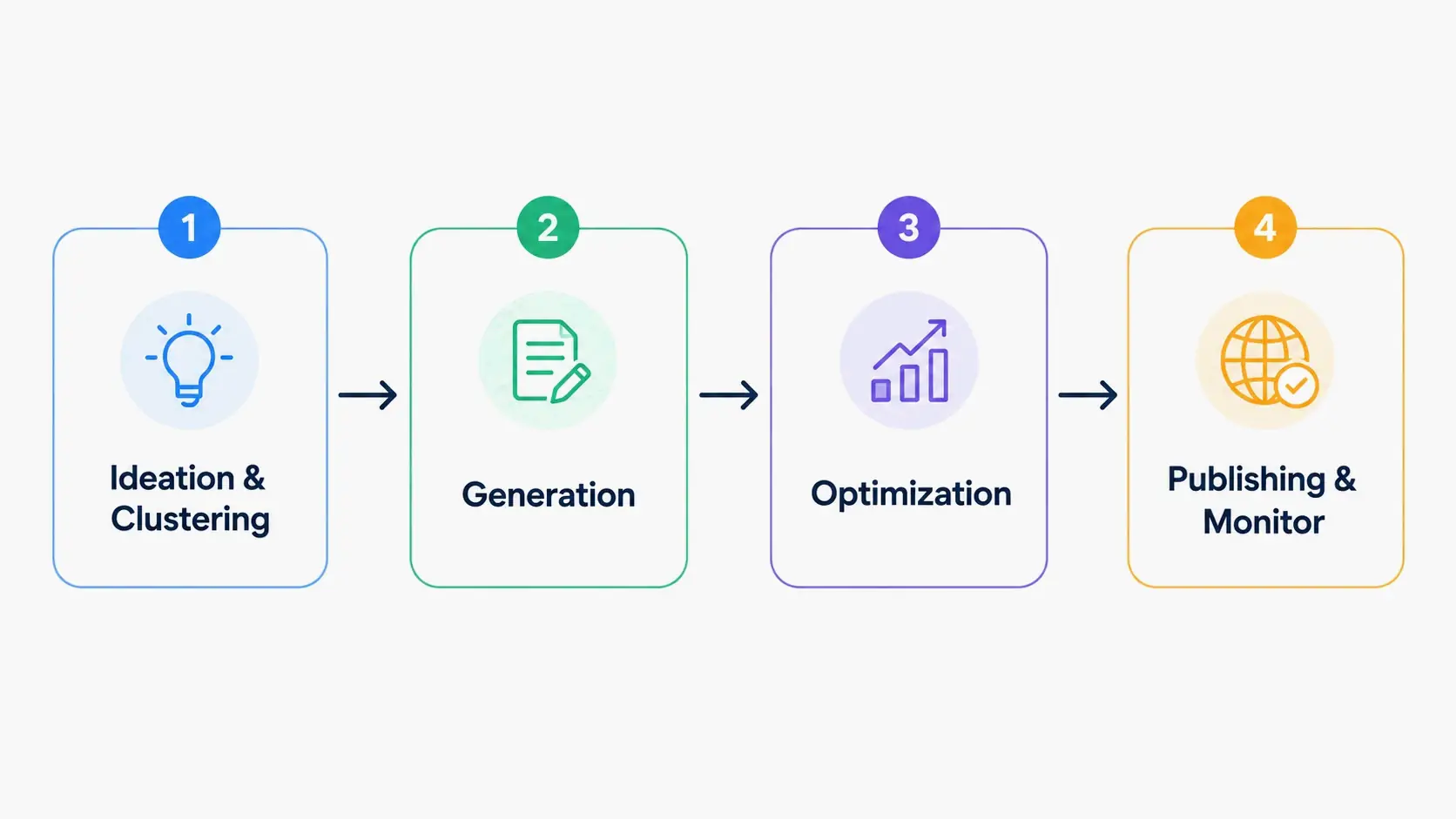
Step 1: Topic ideation and keyword clustering
Use Keyword Insights or Semrush One to identify keyword clusters with realistic ranking potential. Keyword Insights groups keywords by SERP similarity, showing which terms belong on the same page and which require separate content. Semrush One’s Keyword Strategy Builder recommends topic clusters based on relevance and traffic potential.
Step 2: Content generation with SEO‑first prompts
Feed your keyword cluster into Surfer SEO’s Content Editor or AISEO.ai’s Article Writer. Both tools analyze top-ranking pages before generating content, ensuring your draft aligns with what search engines reward. Set brand voice parameters to avoid generic output.
Step 3: Optimization
Run the generated draft through Surfer SEO’s Content Score or Frase’s Auto-Optimize. Check for missing NLP keywords, weak heading structures, and internal linking opportunities. Surfer’s Coverage Booster identifies facts and subtopics covered by competitors but missing from your piece. Enable auto internal linking to strengthen topical connections across your site.
Step 4: Publishing and ranking monitoring
Use Outrank’s direct CMS integration to publish without manual formatting. Monitor performance with Semrush Position Tracking for keyword rankings, and Semrush One’s AI Visibility Toolkit for prompt-level AI search presence. For budget-conscious teams, SE Ranking offers rank tracking and AI visibility monitoring starting at $52/month.
The Minimum Viable Workflow for a New Website (Budget‑Friendly)
If you’re launching a new site with limited budget, start with these three tools:
- Keyword Insights ($29–$49/month) for SERP-based keyword clustering and content briefs
- AISEO.ai ($15/month) for AI writing, humanization, and basic GEO optimization
- SE Ranking ($52/month) or Ubersuggest ($29/month) for rank tracking and competitor analysis
This combination covers research, creation, optimization, and monitoring for under $100/month. Publish 8–12 targeted articles per month and monitor rankings for 90 days before scaling.
Getting Your AI Content Into AI Overviews: The GEO Playbook for 2026
Generative Engine Optimization (GEO) is the practice of optimizing content so it gets cited and surfaced by AI-powered search engines—including Google AI Overviews, ChatGPT, Perplexity, and Gemini. As search behavior shifts toward conversational AI, GEO has become as important as traditional SEO.
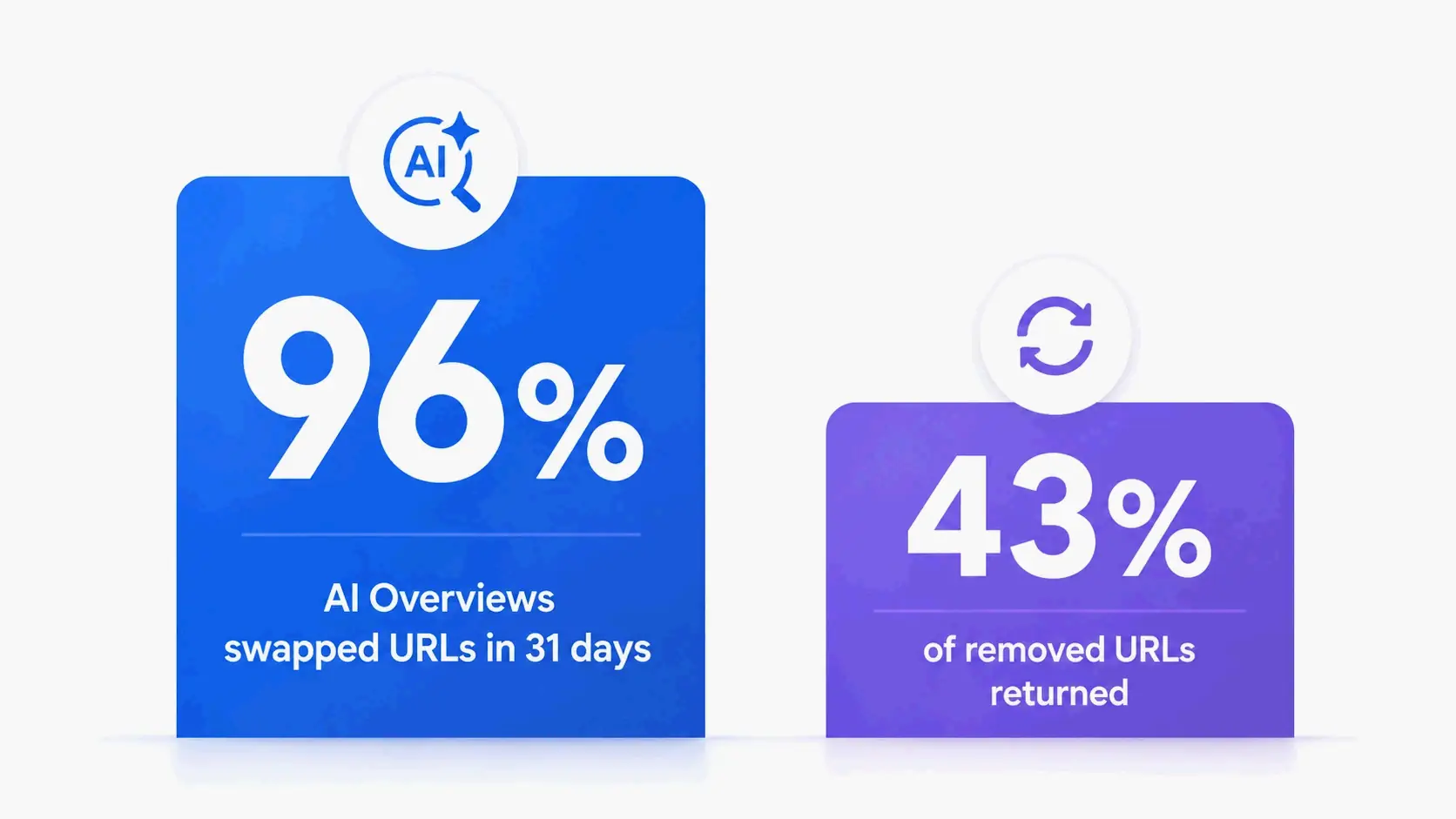
The urgency comes from volatility. According to a Semrush study tracking over 3,000 keywords where AI Overview appeared for at least 20 days in a month, not a single keyword had the same URLs 100% of the time. 96% of AI Overviews swapped out domains within 31 days, and 91% of tracked URLs were removed from AI Overviews at some point. Only 43% of those removed URLs returned later that month.
AI SEO content writers support GEO through several mechanisms:
- Structured data: Tools like Frase and Surfer SEO optimize content structure for clear, extractable answers.
- Authoritative citations: Semrush One’s cited-source analysis shows which domains are referenced in AI answers, enabling gap analysis.
- NLP-optimized snippets: AISEO.ai’s GEO suite prepares content specifically for LLM citation by focusing on clear, well-sourced claims.
Danny Sullivan’s guidance at Google Search Central Live reinforces that there’s no separate playbook: “The fundamentals that have always mattered, such as helpful content and genuine expertise, are the same fundamentals that AI search rewards.” Focus on non-commodity content—original data, real experience, and depth that cannot be easily summarized by AI.
Why Traditional SEO Tactics Still Work – and What to Adjust for AI Answers
Traditional SEO fundamentals remain valid, but three adjustments will improve AI visibility:
- Structure for extraction: Use clear H2s, bullet points, and summary paragraphs that AI models can extract directly.
- Cite authoritative sources: AI models prioritize verifiable claims. Tools like Keyword Insights now auto-cite sources for every claim.
- Monitor citation share: Track not just your keyword rankings, but whether your content is referenced in AI answers. Semrush One, KIME, and Surfer AI Tracker all provide this data.
Conclusion
An AI SEO content writer is not just a text generator—it’s a complete system for producing content that works across both search engines and AI overviews, at scale. Start by defining your budget and workflow needs, then pick one tool from the list that fits your expertise level: Semrush One for all-in-one SEO and AI visibility, Surfer SEO for optimization-first workflows, AISEO.ai for affordable writing and humanization, or GEOWriter — an AI SEO content writer that eliminates the trade-off between production speed and E-E-A-T quality by handling real-time SERP analysis, content generation, automated visuals, and WordPress publishing in a single five-minute workflow.
FAQ
Does Google penalize AI-generated content?
Google does not penalize AI content per se, but it enforces quality standards through its helpful content system and E-E-A-T guidelines. AI content must demonstrate expertise, originality, and value; simply spinning or mass-producing low-effort content can lead to manual actions. Tools like Surfer SEO and AISEO.ai help ensure AI content meets these quality benchmarks.
Can AI SEO content writers help optimize for AI search results like ChatGPT?
Yes—through Generative Engine Optimization (GEO) features that structure content for AI answers. Many tools, including Semrush One and Outrank, now include AI-visibility scoring and snippet generation designed for LLM citations. Focus on clear, authoritative, well-sourced claims to increase chances of being quoted in AI overviews.
What should I look for when choosing an AI SEO content writer tool?
Key criteria: real-time SERP analysis and NLP scoring, GEO support, automated publishing/internal linking, E-E-A-T alignment, and transparent pricing. Beginners benefit from all-in-one platforms like Semrush One; advanced users may prefer specialized tools like Surfer SEO for optimization. Always test with a free trial to evaluate content quality and integration with your existing stack.