Most people do not struggle with opening PowerPoint. They struggle with turning ideas into a clear, good-looking deck.
You need to decide the slide order, write the content, choose a layout, find visuals, and make everything feel consistent. This can take hours, especially when the presentation is for work, school, clients, or investors.
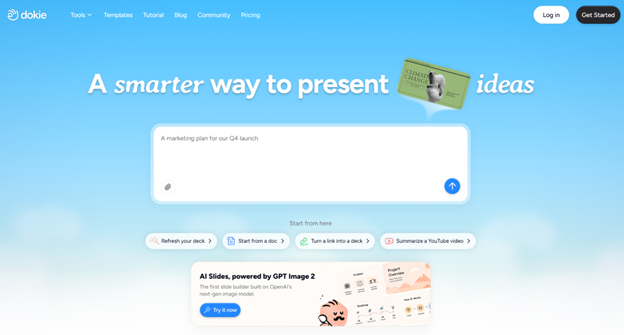
Dokie AI is built to make this process faster. It helps users create structured PPT-style presentations with AI. The latest highlight is its support for GPT Image 2, which improves the quality of images generated inside the slides.
This makes Dokie AI more useful for people who want presentations that look polished, not just quickly generated.
What Is Dokie AI?
Dokie AI is an AI presentation maker for business-ready PPT that helps users create editable PowerPoint-style decks. You can start with a simple topic, a detailed prompt, notes, documents, or existing content.
The tool can help generate a complete presentation draft, including slide structure, content points, layouts, and visuals. Users can then edit the deck, add real data, adjust the design, and export the final result.
Dokie AI is useful for many presentation types, such as:
Business reports
Pitch decks
Marketing plans
Product updates
Client proposals
Education slides
Training materials
Technology presentations
Personal portfolio decks
The main benefit is that Dokie AI reduces the time spent on the first draft. Instead of building everything from zero, users can start with an organized deck and improve it from there.
GPT Image 2 Gives Dokie AI a Strong Visual Advantage
The most important upgrade in Dokie AI is support for GPT Image 2.
This matters because visuals are often the weakest part of AI-generated presentations. Many tools can create text and layouts, but their images may feel random or low-value. The result is a deck that looks like it was made quickly, but not carefully.
With GPT Image 2, Dokie AI can generate visuals that are more refined and more connected to each slide’s meaning. The images can better match the topic, tone, and presentation context.
This is especially useful when you need slides that look professional enough to share with a team, client, teacher, or investor.
Less Generic, More Presentation-Ready
A common issue with AI slides is that the visuals feel like placeholders.
For example, a slide about business strategy may use a vague office image. A slide about product innovation may use a random tech background. A slide about education may use a basic classroom image that adds little value.
Dokie AI’s GPT Image 2 support helps reduce this problem. The generated images feel more intentional. They are not just filling empty space. They can help support the message of the slide.
This makes the presentation look more complete from the beginning.
Better Visual Support for Complex Topics
Some presentation topics are hard to explain with text alone.
For example, product workflows, AI automation, market trends, customer journeys, healthcare topics, and business strategies all benefit from strong visuals.
Dokie AI can use GPT Image 2 to create images that help explain these ideas more clearly. This is useful when the audience needs to understand a concept quickly.
For a product deck, visuals can help show use cases or workflows.
For a marketing deck, visuals can support campaign ideas and audience insights.
For a business report, visuals can make the deck feel more polished and less text-heavy.
For an education deck, visuals can make lessons easier to follow.
This is where improved image generation becomes more than a design upgrade. It improves communication.
Stronger Deck Flow
Dokie AI is not only focused on image quality. It also helps users create better presentation structure.
A good presentation should feel like a story. The slides should connect naturally. The audience should understand why each slide exists and what comes next.
Dokie AI helps create this flow by organizing content into logical sections.
For a business report, the deck may move from summary to data, insights, challenges, and next steps.
For a pitch deck, it may move from problem to solution, product, market, traction, and ask.
For a marketing plan, it may move from goals to audience, channels, budget, timeline, and KPIs.
This structure makes the deck easier to edit and present.
Why This Matters for Business Users
Business users need presentations that are clear, credible, and ready to use.
A deck for a client meeting, strategy review, sales pitch, or investor update cannot look like a random collection of AI-generated slides. It needs a strong structure and a consistent visual style.
Dokie AI helps with both. It can build the deck outline and slide flow, while GPT Image 2 improves the visual quality.
This makes Dokie AI useful for:
Weekly reports
Monthly reviews
Strategy decks
Product updates
Sales presentations
Client proposals
Pitch decks
Marketing reports
Training slides
The result is not just faster slide creation. It is a stronger first draft that needs less basic cleanup.
Good for Marketers and Founders
Marketers often need to create decks for campaigns, SEO reports, launch plans, social media strategies, and performance reviews.
Dokie AI can help turn scattered notes into a clear deck. GPT Image 2 then helps make the slides more visually engaging.
Founders can also benefit from Dokie AI when creating pitch decks, investor updates, product decks, or business proposals. A founder still needs to add real numbers, traction, screenshots, and storytelling, but Dokie AI can help build a better starting point.
This is useful when speed matters but quality still matters too.
Useful for Education and Training
Dokie AI is also helpful for teachers, students, and trainers.
Education presentations need to be clear and easy to follow. Too much text can make slides boring. Weak visuals can make the topic harder to understand.
With GPT Image 2 support, Dokie AI can create more useful visuals for learning content. This can help explain concepts, support examples, and make the deck more engaging.
Students can use it for class presentations and research reports. Teachers and trainers can use it for lessons, workshops, and training decks.
PPT Templates for Different Use Cases
Dokie AI also includes PPT templates for different presentation types.
The template categories include Business, Education, Marketing, Medical, Technology, Pitch Deck, About Me, and Infographics.
This helps users avoid starting with the wrong style. A business deck should look clean and professional. A pitch deck should feel persuasive. An education deck should be readable. An infographic deck should make information easier to scan.
Templates give users a faster starting point and help the final deck feel more organized.
Free PPT Tools
Dokie AI also offers free PPT tools for turning existing content into slides.
These include PDF to PPT, Word to PPT, Text to PPT, Excel to PPT, JPG to PPT, PNG to PPT, HTML to PPT, and DOC to PPT.
This is useful because many presentations begin with existing materials. You may already have a report, document, spreadsheet, image, or webpage. Dokie AI helps turn those materials into a PPT workflow faster.
This makes Dokie AI practical for real office and study tasks, not just prompt-based slide generation.
Pros of Dokie AI
Dokie AI makes it easier to create a complete presentation draft quickly.
It focuses on structure, so the deck feels more logical and easier to present.
Its GPT Image 2 support improves image quality, visual relevance, and overall slide polish.
It offers templates for many use cases, including business, education, marketing, medical, technology, pitch decks, about me slides, and infographics.
It also provides free PPT tools for converting existing files into presentation-ready content.
Cons of Dokie AI
Dokie AI still requires editing.
Users should check the content, facts, numbers, and slide order before using the final deck. Important presentations still need real data, brand elements, screenshots, and final design review.
The quality also depends on the prompt. A clear prompt with audience, goal, slide count, and key points will usually create a better result than a broad one-line request.
Who Should Use Dokie AI?
Dokie AI is a good choice for users who create slides often.
Office workers can use it for reports, meetings, and team updates.
Marketers can use it for campaign decks, SEO reports, launch plans, and strategy presentations.
Founders can use it for pitch decks, investor updates, and product decks.
Teachers and students can use it for lessons, class projects, and research presentations.
Consultants and agencies can use it for client proposals, audit reports, and strategy decks.
Product teams can use it for roadmaps, product updates, and technical explainers.
Final Verdict
Dokie AI is a strong AI PPT maker for users who want faster presentation creation with better visuals.
Its support for GPT Image 2 is a key advantage. The generated images feel more polished, more relevant, and more useful for real slide decks. This helps the presentation look more professional from the first draft.
At the same time, Dokie AI keeps the focus on structure. That is important because a presentation should not only look good. It should also be clear, logical, and easy to present.
For business users, marketers, founders, teachers, students, consultants, and teams that create PPTs often, Dokie AI is worth trying.
FAQs
1. What is Dokie AI?
Dokie AI is an AI PPT maker that helps users create editable PowerPoint-style presentations from prompts, notes, documents, and existing content.
2. Does Dokie AI support GPT Image 2?
Yes. Dokie AI supports GPT Image 2, which improves the quality and relevance of images generated for presentation slides.
3. Why is GPT Image 2 important for Dokie AI?
GPT Image 2 helps Dokie AI generate visuals that look more polished, more detailed, and more connected to the slide topic.
4. Is Dokie AI useful for business presentations?
Yes. Dokie AI is useful for business reports, client proposals, pitch decks, product presentations, strategy decks, and marketing plans.
5. Does Dokie AI have free PPT tools?
Yes. Dokie AI offers free PPT tools such as PDF to PPT, Word to PPT, Text to PPT, Excel to PPT, JPG to PPT, PNG to PPT, HTML to PPT, and DOC to PPT.